

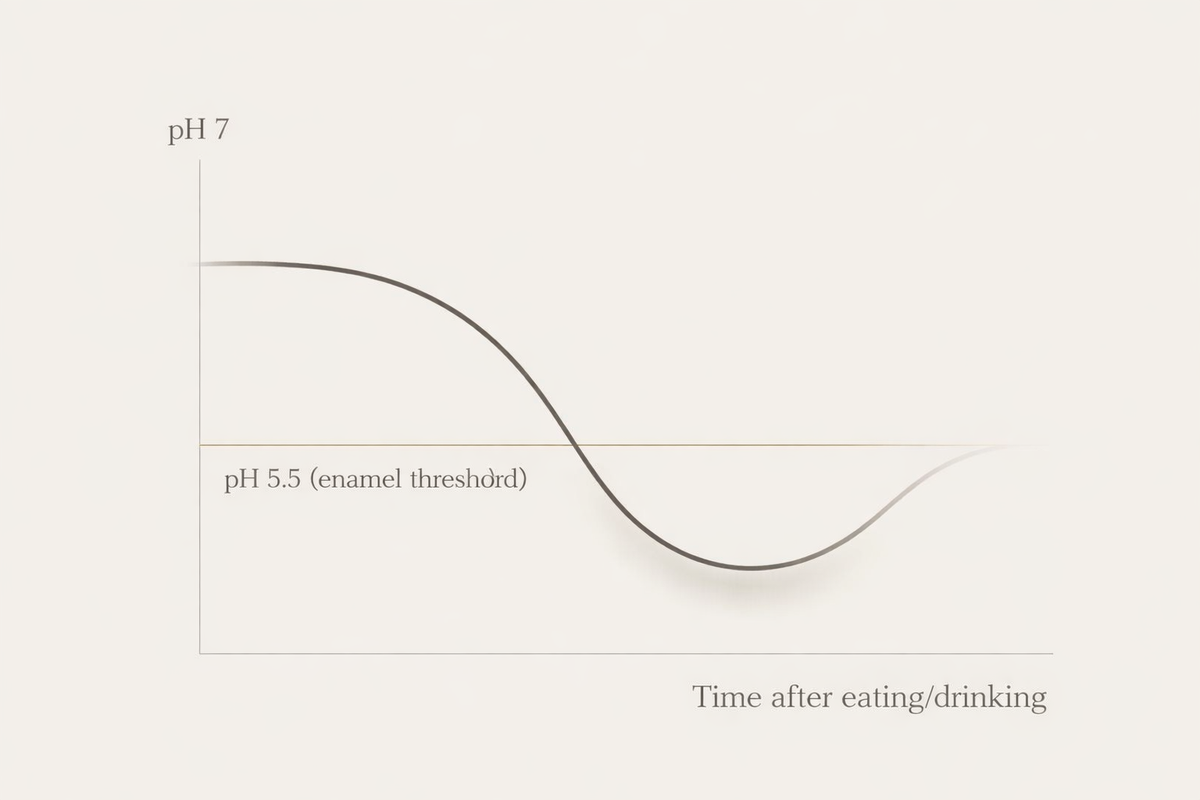
The graph that quietly changed preventive dentistry
Most people have never heard of Stephan’s Curve.
Yet almost every dentist has.
Published in 1943, it’s one of the most important discoveries in preventive dentistry because it explains something surprisingly simple:
Your smile doesn’t change when you brush.
It changes in the hours between brushing.
A simple graph with a powerful message
Stephan’s Curve tracks what happens inside your mouth every time you eat or drink.
Within just a few minutes, the pH of dental plaque falls sharply. When it drops below around pH 5.5, the surface of enamel begins to lose minerals. This is known as an acid attack.
The surprising part isn’t that it happens.
It’s how long it lasts.
After every meal, coffee, snack or sugary drink, your mouth can spend the next 20 to 40 minutes slowly recovering as saliva neutralises the acid and begins replacing the minerals that have been lost.
Your mouth is remarkably good at repairing itself.
It simply needs the opportunity.
The insight most people never hear
The real lesson from Stephan’s Curve isn’t about how much sugar you consume.
It’s about how often you ask your teeth to recover.
Every eating occasion starts the process again.
Breakfast.
A mid-morning coffee.
Lunch.
An afternoon snack.
Dinner.
An evening treat.
Each one creates another acid challenge and restarts the recovery clock.
Over time, it isn’t one indulgence that matters most.
It’s the accumulation of hundreds of small interruptions to your mouth’s natural recovery process.
Recovery is part of the routine
For decades, oral care has focused almost entirely on brushing.
But brushing is only the beginning.
The majority of your day is spent away from the bathroom sink, while your mouth moves through repeated cycles of acid exposure and recovery.
This is when remineralisation naturally takes place as saliva helps restore minerals to enamel.
Understanding that recovery window changes how you think about daily oral care.
Not as something you do twice a day.
But as a system that supports your smile throughout the day.
Why we created Smile Boosters™
Smile Boosters™ was created around a simple observation from clinical practice.
People were brushing.
They were attending the dentist.
Many were doing everything they had been taught.
Yet the biology of what happened between those moments was largely being ignored.
Our slow-dissolving tablet is designed for the hours between brushing—working alongside your existing routine rather than replacing it.
Because oral care shouldn’t end when you leave the bathroom.
Three simple ways to work with your biology
- Reduce unnecessary grazing. Fewer eating occasions mean fewer acid attacks and more uninterrupted recovery time.
- Give enamel time before brushing. After eating, especially acidic foods and drinks, allow your mouth to recover before brushing.
- Think beyond brushing. The hours between meals are where much of your smile’s story is written.
Stephan’s Curve has been quietly shaping preventive dentistry for more than eighty years.
Most people have never seen it.
Once you understand it, it’s difficult to think about oral care in quite the same way again.
Share: